A manager will contact you and answer all your questions
Leave a request, and we will arrange a convenient time for a meeting. Full confidentiality guaranteed
We use cookies to ensure the website works properly.
By continuing to use it, you agree to the processing of your cookies.
By continuing to use it, you agree to the processing of your cookies.
The #1 Crisis PR Mistake: How "Helpful" Employees Can Destroy Your Reputation
In crisis management, there is one ironclad rule: nobody talks to the press without clearance. When a company is managing a live incident, a single off-the-cuff remark from a well-meaning employee can completely derail a carefully coordinated brand-protection strategy. To show you just how quickly control can slip away, let’s look at a classic cautionary tale from the industrial sector.
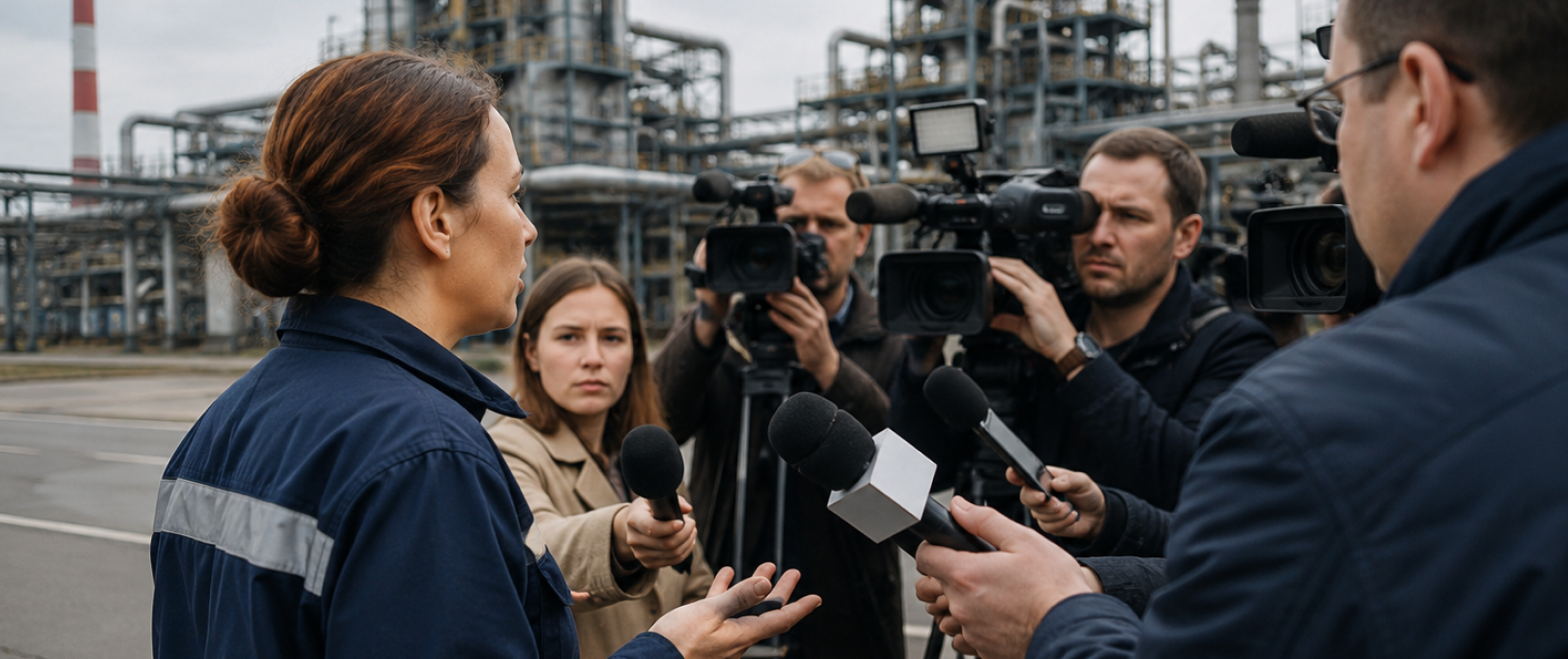
Picture a major oil refinery hit by a massive fire. For any industrial facility, an emergency like this is pure chaos, but the crisis response team reacts swiftly. The PR department immediately rolls out a holding statement to control the narrative, successfully stabilizes the media landscape, and works in parallel on a detailed official update. Meanwhile, news crews gather outside the refinery gates, hungry for a sensational scoop. But with no dramatic updates coming their way, the reporters start packing up their gear. The crisis is nearly contained.
At that exact, critical moment, an employee from the company„s internal newsletter walks out to the gates. Driven purely by good intentions and a desire to «help out» the reporters she knows personally, she stands against the backdrop of the blazing facility and offers her own casual take:
«A flange blew out, lost pressure… hey, it happens».
Those few seconds of footage instantly make the evening network news. Consequently, instead of a controlled, factual narrative, the media gets the perfect negative package: a massive fire in a populated area, backed by an insider source implying that such accidents are just business as usual. In just one minute, a single interview completely neutralized the PR team's damagecontrol efforts.
This case highlights a brutal truth in crisis communications: impulsive commentary from frontline staff can inflict irreversible reputational damage in seconds. The real challenge is that employees often act with the best intentions, genuinely believing they are stepping up to defend their company-only to inadvertently throw fuel on the fire. This is exactly why tight media protocols are non-negotiable during a crisis. The authority to speak on behalf of the organization must rest solely with designated, media-trained spokespeople. Every other member of the team, from frontline staff to department heads, must follow one simple, foolproof protocol: politely decline to comment and immediately route all media inquiries to the press office.
Safeguarding your reputation in a crisis goes far beyond drafting polished press releases; it requires alignment across your entire workforce. Our agency helps businesses build airtight internal and external media security systems. We handle the full lifecycle of preparing your business for any unforeseen scenario. By taking a systemic approach to workforce training, you effectively eliminate the human error factor and insulate your business from sudden, devastating PR crises.
At that exact, critical moment, an employee from the company„s internal newsletter walks out to the gates. Driven purely by good intentions and a desire to «help out» the reporters she knows personally, she stands against the backdrop of the blazing facility and offers her own casual take:
«A flange blew out, lost pressure… hey, it happens».
Those few seconds of footage instantly make the evening network news. Consequently, instead of a controlled, factual narrative, the media gets the perfect negative package: a massive fire in a populated area, backed by an insider source implying that such accidents are just business as usual. In just one minute, a single interview completely neutralized the PR team's damagecontrol efforts.
This case highlights a brutal truth in crisis communications: impulsive commentary from frontline staff can inflict irreversible reputational damage in seconds. The real challenge is that employees often act with the best intentions, genuinely believing they are stepping up to defend their company-only to inadvertently throw fuel on the fire. This is exactly why tight media protocols are non-negotiable during a crisis. The authority to speak on behalf of the organization must rest solely with designated, media-trained spokespeople. Every other member of the team, from frontline staff to department heads, must follow one simple, foolproof protocol: politely decline to comment and immediately route all media inquiries to the press office.
Safeguarding your reputation in a crisis goes far beyond drafting polished press releases; it requires alignment across your entire workforce. Our agency helps businesses build airtight internal and external media security systems. We handle the full lifecycle of preparing your business for any unforeseen scenario. By taking a systemic approach to workforce training, you effectively eliminate the human error factor and insulate your business from sudden, devastating PR crises.
ARM Blog
[blog]

How One Unapproved Comment Undermined Crisis Communications
The story of how an employee’s spontaneous remark to journalists completely bypassed the PR team, creating a hostile media narrative
around an oil refinery fire. We break down this real-world case to explain why only trained spokespersons delivering a single, unified position should ever speak to the press during a crisis.
around an oil refinery fire. We break down this real-world case to explain why only trained spokespersons delivering a single, unified position should ever speak to the press during a crisis.

Why Simply Writing a Wikipedia Article Is Not Enough
We explain why public recognition, professional achievements, and state awards do not guarantee that an article will be permanently accepted on Wikipedia. Using a real case study, we examine content removals, "edit wars," strict notability assessments, and why securing an article can take several months.

Why Microcommunities Influence Reputation More Than Large-Scale Advertising
We explain why recommendations in niche thematic groups and targeted chats often inspire far more trust than traditional media placements or advertising campaigns. We analyze the rising role of microcommunities in reputation marketing and their direct impact on audience decision-making.


Leave a request, and we’ll answer all your questions
Our manager will contact you and answer all your questions